What a ridiculous iPhone game taught me about attention, resilience and bringing your best to work
Back in 2008, my wife Nicole and I had just moved to Saskatoon, Saskatchewan, Canada, after living in Toronto. It was around the time when games on phones were becoming much more of a thing, and somewhere along the way I discovered a tower-defence-style game that became far more important to me than it had any right to be.
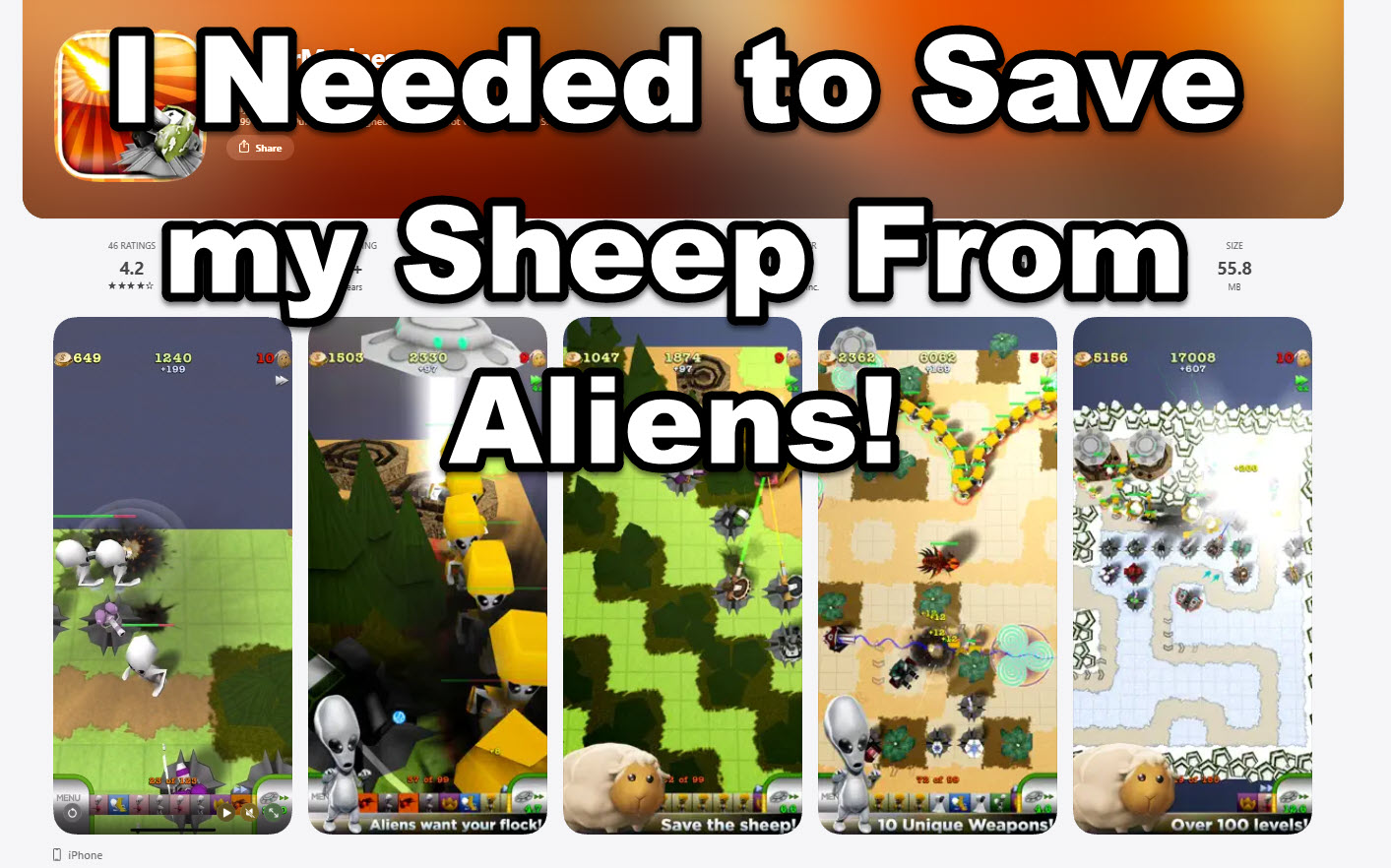
The basic premise was simple. Aliens were coming to steal my sheep, and it was my responsibility to stop them.
I had mortar guns. I had plasma guns. I had upgrades, strategies and increasingly complicated decisions to make about where to position my defences.
Most importantly, I had sheep that apparently could not survive without me.
I became quite good at this game. Of course, as I became better, the levels became harder, and that was where things started to get a little ridiculous.
I would be lying in bed beside Nicole late at night telling myself, Just one more level.
One more level would become another attempt. Then another. Then perhaps a strategic rethink because clearly I had upgraded the mortar gun too early and what any sensible shepherd really needed was more plasma capability.
Before I knew it, Nicole was sound asleep and I was still awake in the early hours of the morning defending imaginary livestock from an extraterrestrial invasion.
Those sheep needed me.
Or at least my brain had become remarkably convinced that they did.
The problem was that the aliens followed me to work
The impact did not stop when I finally put my phone down.
I would wake up tired, my morning routine would be out of rhythm and I would start the day feeling sluggish. Even stranger, I sometimes caught myself thinking about the game during the following day. A part of my mind was still trying to solve the problem.
What if I upgraded that gun first?
Maybe I positioned the tower incorrectly.
I reckon I could beat that level tonight.
At the time, I worked in sales at a computer store. I did my job, served the customers who came to me and made sales, but when I reflect on that period now, I can see that I wasn’t always bringing the energy or initiative that I was capable of bringing.
I wasn’t consistently looking for the extra opportunity, approaching another customer, thinking creatively about how I could help someone or challenging myself to improve my results.
My sales were a little flat.
Meanwhile, another part of my motivational system was operating at full capacity.
Unfortunately, it was focused on sheep.
Looking back at it now makes me laugh, but there is an important lesson buried inside this slightly embarrassing chapter of my life.
The game wasn’t evil. Gaming isn’t inherently bad. Entertainment isn’t bad. Switching off isn’t bad either.
The issue was much simpler: something that mattered very little was receiving a disproportionate amount of my attention, thought and energy.
And attention matters enormously when we are trying to perform at our best.
Your brain is constantly learning what deserves your attention
There is an interesting connection here with how motivation and reward work in the brain.
You may have heard dopamine described as the brain’s “pleasure chemical”, but that explanation is far too simplistic. Dopamine is involved in several important processes, including motivation, learning, anticipating rewards and helping the brain learn which behaviours are worth repeating.
That is actually good news. We need these systems. They help us pursue goals, learn new skills and remain motivated.
The challenge is that our brains don’t automatically reserve these motivational processes for things that are deeply meaningful.
A game can provide a beautifully clear objective: save the sheep.
It provides rapid feedback: you saved 17 sheep but lost three.
It provides challenge: try again.
It provides progress: upgrade unlocked.
It provides anticipation: perhaps this next attempt will be the one.
Then there is the particularly powerful experience of almost succeeding. When you get tantalisingly close to beating a difficult level, walking away can become surprisingly difficult. Your mind wants to solve the problem.
This doesn’t mean games are uniquely dangerous. Similar patterns can occur with social media, news feeds, online shopping, streaming services, email, messages, sport, work itself and countless other activities.
The more useful question is not:
“Is this thing bad?”
A much better question is:
“Is this receiving more of my attention than it deserves?”
That is a very different conversation.
It isn’t about guilt. It is about awareness.
You only have so much attention to invest
I sometimes talk about “brain energy”, although technically our brains are obviously much more complicated than a battery that simply runs down during the day. A better way to think about it might be our mental bandwidth — our capacity to concentrate, regulate our responses, make decisions, solve problems and stay engaged with what is in front of us.
There is a cost when that attention becomes repeatedly fragmented.
Research into attention residue, for example, has explored what happens when we move from one task to another while part of our attention remains connected to what we were doing before. An unfinished activity can continue occupying some of our thinking even though we have physically moved on to something else.
I can certainly relate.
My body may have been standing in a computer store in Saskatoon, but apparently part of my cognitive processing was still stationed on an alien battlefield protecting livestock.
We experience more professional versions of this every day.
You read a frustrating email and immediately walk into an important meeting.
You leave one piece of work unfinished and jump into another.
You check your phone halfway through writing something important and suddenly disappear down an entirely different path.
You move between email, Teams, a spreadsheet, a phone call and a conversation with someone sitting beside you.
Then you wonder why concentrating on one meaningful task feels difficult.
It isn’t necessarily because you have suddenly become incapable of focusing. Your attention may simply have been given too many places to live.
I was also stealing something from tomorrow
There was another fairly obvious problem with my alien-fighting career.
Sleep.
When I stayed up ridiculously late attempting to beat another level, I wasn’t simply spending more time playing a game. I was taking something away from the following day.
Sleep plays an important role in attention, learning, emotional regulation, memory and cognitive performance. When we consistently sacrifice it, we can make it harder to bring the clarity and composure we need the next day.
That matters in almost every profession.
If you are leading people, you need enough capacity to listen properly and regulate your response when something doesn’t go according to plan.
If you work in sales, you need the energy to initiate rather than simply react.
If you are presenting, making decisions, solving problems, managing conflict or collaborating with colleagues, your state matters.
You can know all the right techniques and still struggle to use them if you arrive exhausted, distracted and mentally somewhere else.
That doesn’t mean we need to become obsessed with optimising every moment of our lives. Nobody needs the pressure of believing that every minute must be productive.
Rest is important.
Play is important.
Fun is important.
Sometimes doing absolutely nothing productive is exactly what we need.
The issue is whether the things we choose to help us recover are genuinely helping us recover — or whether they are quietly interfering with our ability to show up the way we want to later.
This is also a resilience conversation
When people hear the word resilience, they often picture someone getting through an enormous crisis. Resilience certainly matters in those moments, but I think we miss something important when we only associate resilience with major adversity.
Resilience also shows up in the ordinary ways we manage ourselves.
How do I respond when something doesn’t go according to plan?
Can I redirect myself after becoming distracted?
How well do I recover?
Can I regulate my response when I’m under pressure?
Do I have habits that support my physical and psychological wellbeing?
Where does my attention repeatedly go?
What do I do when motivation disappears?
Can I recognise when one of my habits is no longer helping me?
Resilience isn’t simply about being tough. Increasingly, resilience research looks at our capacity to adapt effectively through a combination of psychological, behavioural, social and biological processes.
That is encouraging because it means resilience isn’t simply something a person either possesses or doesn’t possess.
There are things we can practise.
There are environments we can change.
There are habits we can strengthen.
There are patterns we can recognise.
And sometimes the most powerful resilience strategy is remarkably simple: stop repeatedly putting yourself in a situation that makes it harder to be the person you want to be.
So one day, I deleted the game
Eventually, I made a significant strategic decision for the future of humanity.
I deleted the game.
No twelve-step programme. No elaborate ceremony. No intervention.
Delete.
Gone.
My sheep were abandoned.
I can only assume the aliens eventually won.
But I never installed that game again, and ever since then I have been cautious about certain types of games because I learnt something useful about myself. Other people may be perfectly capable of playing them for 20 minutes, putting the phone down and never thinking about them again.
Apparently, I am capable of developing an emotional commitment to fictional sheep.
So rather than repeatedly trying to exercise heroic levels of willpower at 12:47 in the morning, I removed the temptation altogether.
That decision also helped reinforce something that has become increasingly important to me over the years: I want to be more intentional about where I direct my attention and how I set myself up to perform.
Setting your brain up for a better day
I am certainly not perfect at this. I still procrastinate sometimes. I still get distracted. I still have mornings that don’t go according to plan. I don’t have a flawless routine that I execute every day.
But the difference between living reactively and intentionally can be enormous.
There are several practices I now find particularly useful.
- Protect tomorrow tonight
A successful morning often begins the evening before. If I repeatedly stay awake much later than I need to, I am making tomorrow harder before tomorrow even arrives.
This doesn’t mean becoming rigid about sleep or never enjoying a late night. It simply means recognising that today’s choices can influence tomorrow’s performance.
- Decide what deserves your attention
If I don’t make intentional choices about where my attention goes, there are plenty of things willing to make that decision for me.
Notifications will do it.
Emails will do it.
News will do it.
Other people’s priorities will do it.
Sometimes simply identifying the two or three things that matter most can dramatically change the way we approach a day.
- Use intentional declarations and self-talk
I often use declarations to redirect myself towards the mindset and behaviour I want to bring into the day.
For me, this isn’t about pretending everything is wonderful or repeating magical phrases until the universe gives me what I want. It is about deliberately directing my thinking.
Who do I want to be today?
What matters today?
How do I want to respond when things become difficult?
One useful approach is to turn intentions into an if–then plan. Instead of simply saying, “I want to stay calm today,” you might decide, “If that difficult issue comes up in the meeting, I will pause, ask a question and make sure I understand before I respond.”
Now the intention has a situation attached to it.
- Visualise the behaviour, not merely the victory
Visualisation can also become more practical when we rehearse the behaviour rather than simply imagining an ideal result.
Imagine yourself walking into the meeting calmly.
Picture yourself delivering the opening of the presentation.
Mentally rehearse making the phone call you have been avoiding.
Picture yourself listening rather than becoming defensive during a difficult conversation.
The aim isn’t fantasy. It is preparation.
- Move your body
Movement is another simple way to support ourselves. Exercise is associated with a wide range of physical and psychological benefits, and even relatively short periods of movement can help us reset.
Sometimes the best thing I can do when my thinking becomes stuck isn’t to think harder.
It is to get up and move.
- Practise realistic positivity
I am a strong believer in positivity, but useful positivity isn’t pretending problems don’t exist.
It is being able to acknowledge reality while still asking constructive questions.
What can I influence?
What is still good?
What can I learn from this?
Who can help?
What is my next useful action?
That is very different from catastrophising, replaying the problem endlessly or surrendering our attention to something we cannot change.
- Make distraction harder
Sometimes we make personal development far too complicated.
Turn off the notification.
Move the phone.
Close the unnecessary tabs.
Write down the thought that keeps interrupting you so your brain doesn’t have to keep holding onto it.
Block out uninterrupted time for important work.
And occasionally…
Delete the game.
High performance isn’t about becoming a machine
I think this distinction is important.
The goal is not to become a relentlessly productive human being who never watches television, never plays a game, never scrolls through anything interesting and turns every spare moment into another performance objective.
That sounds exhausting.
High performance should not mean losing the ability to enjoy your life.
Instead, it means developing the self-awareness to recognise what helps you and what hinders you. It means understanding how to recover, how to focus, how to respond to pressure and how to give yourself a better chance of bringing your abilities into the moments that matter.
At Breakthrough Corporate Training, we spend a great deal of time helping people strengthen their communication, leadership, resilience and interpersonal effectiveness. Underneath all of these capabilities sits an important reality:
Your skills matter, but so does the state in which you use them.
A highly capable leader who is exhausted and mentally distracted may not lead at their best.
A talented salesperson who is continually reactive may stop looking for opportunities.
A knowledgeable communicator who is emotionally overloaded may struggle to listen.
A person can have enormous potential and still create daily conditions that make accessing that potential more difficult.
The encouraging part is that many of those conditions can change.
So… what is stealing your sheep?
Perhaps there is nothing dramatic you need to overhaul.
Maybe you need to go to bed 30 minutes earlier.
Perhaps you need to stop beginning every morning with everyone else’s notifications.
Maybe you need to move more.
Perhaps you need to protect an hour of uninterrupted work.
Maybe there is one distracting app that needs to disappear from your phone.
Perhaps you need to start your morning by reminding yourself who you want to be rather than immediately reacting to everything happening around you.
The point isn’t to feel guilty about the things you enjoy.
It is to become curious about the things that repeatedly receive your attention.
Ask yourself:
Is this helping me recover, grow and live well — or is it receiving more of me than I actually want to give it?
I can look back now and laugh about my alien-and-sheep era. It was genuinely ridiculous.
But it also taught me something I have never forgotten.
The aliens weren’t real. The sheep were pixels. But the attention I was spending on them was very real.
So was the sleep.
So was the motivation.
So was the opportunity cost.
Today I would much rather direct more of that attention towards my family, my health, the people I work with, the people I’m serving, meaningful goals and continuing to become the person I want to be.
Enjoy your games. Enjoy your Netflix. Enjoy your scrolling. Enjoy whatever helps you relax and have some fun.
Just make sure that somewhere along the way you are also deliberately switching on for the things that matter.
And if aliens ever really do arrive in Saskatchewan looking for sheep…
Give me a call.
I have considerable experience.
And I know exactly where to position the plasma guns.
Build the resilience to perform at your best
If this article has prompted you to think about how you or your team manage attention, pressure, recovery and everyday resilience, this is exactly the kind of capability we explore through The Breakthrough Resilience and Well-being Course©.
The programme explores the neuroscience of resilience, practical resilience-building tools and the six PR6 resilience domains of Vision, Composure, Reasoning, Health, Tenacity and Collaboration. Participants also complete the Predictive 6-Factor Resilience Assessment©, helping move the conversation beyond generic advice and towards a clearer understanding of where resilience can be strengthened.
Explore The Breakthrough Resilience and Well-being Course led in Sydney, Australia or online with your leaders and team:
Learn more about the course
Because sometimes becoming more resilient isn’t about pushing yourself harder.
It’s about learning how to direct your energy, attention and responses towards what matters most.
#Resilience #WorkplaceResilience #WellbeingAtWork #HighPerformance #MentalFitness #LeadershipDevelopment #PersonalDevelopment #WorkplaceWellbeing #EmployeeWellbeing #BreakthroughCorporateTraining